Your CRM already holds a huge amount of information about your customers: where a lead came from, which vehicle they are interested in, what they have done online, who has contacted them, and where they are in the sales process. The challenge is turning that information into communication that actually reflects what the customer wants. A modern CRM cannot simply store leads and assign the next task. Dealerships increasingly need technology that understands customer context, connects past conversations, and helps employees move opportunities forward without making shoppers repeat themselves.
That does not necessarily mean replacing the CRM. For many dealerships, the better answer is adding intelligence to the systems they already use. Matador AI works alongside dealership technology to help sales and service teams respond, follow up, and engage customers across text, email, chat, voice, and video while keeping the dealership team involved where it matters most.
Not Every Lead Should Get the Same Follow-Up
Dealerships already collect information from website forms, digital retailing tools, trade valuations, finance applications, OEM leads, marketplaces, calls, showroom visits, and service interactions. The issue is what happens after that information comes in. Someone who uses a payment calculator is giving the dealership a different signal than someone asking whether a specific vehicle is available. But in many dealerships, both leads can still end up receiving the same follow-up.
The CRM needs to support that distinction. Customer communication should reflect lead source, shopping activity, previous conversations, employee notes, and the type of action the shopper has taken. The source material specifically highlights the need to differentiate workflows for digital retail, build-your-own, finance application, trade value, and payment calculator leads rather than treating every opportunity the same way. Matador builds on this information so conversations can respond to what the customer is actually doing instead of relying on generic dealership follow-up.
For dealership marketing teams focused on lead generation, this matters because generating more opportunities is only valuable if those opportunities are handled effectively once they enter the dealership. Better use of existing customer data can help turn more of that marketing investment into active conversations and improve lead conversion without simply increasing lead volume.
Lead Response Time Matters, but Relevance Matters Too
Dealerships have spent years focusing on lead response time, and speed remains important. Customers often reach out to multiple stores, shop outside business hours, and expect quick answers when they ask a question. AI gives dealerships the ability to respond consistently even when the sales floor or BDC is busy.
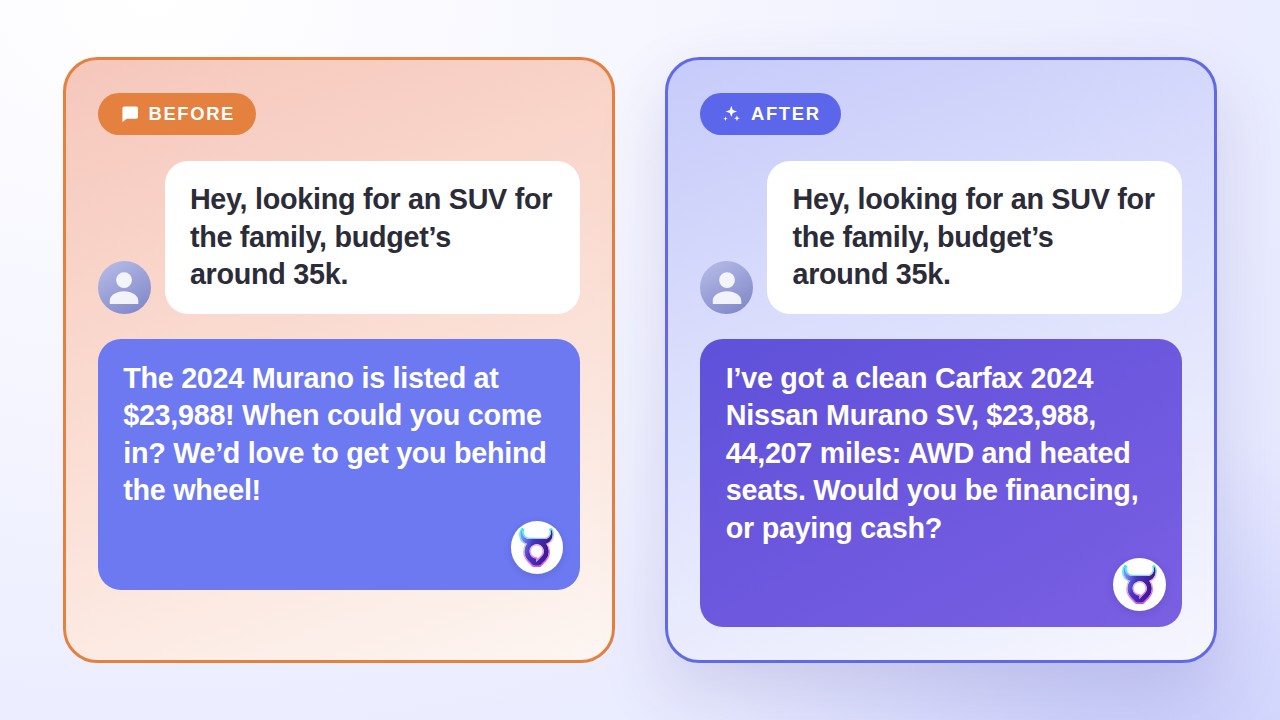
The risk is confusing faster communication with better communication. A CRM can send hundreds of automated texts or emails, but that does not mean those interactions are useful. The source material points specifically to generic messages such as “just following up” and “are you still in the market?” as examples of communication that creates activity without necessarily creating a meaningful customer conversation.
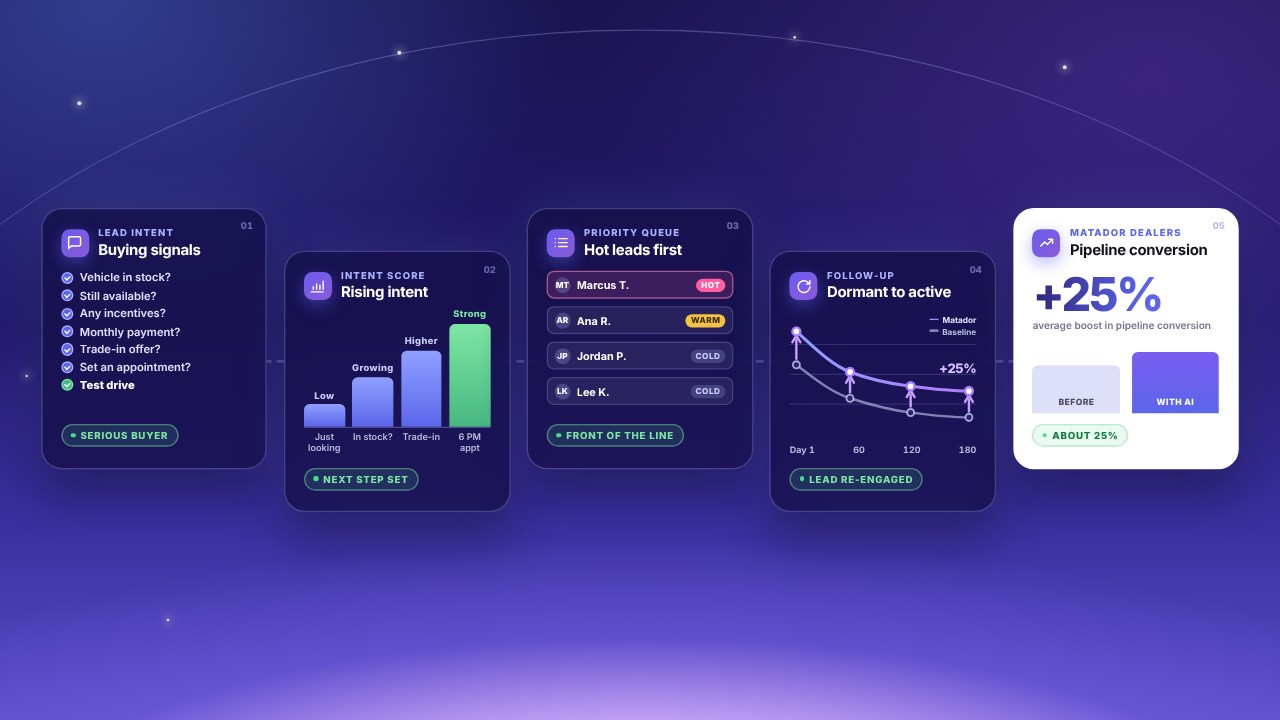
This is where conversational AI for dealerships can add more value than basic automation. Matador AI uses customer and dealership context to help determine how a conversation should continue. AI Engage can begin the conversation when a new lead arrives, AI Reply responds when the customer writes back, and AI Follow-Up can re-engage opportunities that have gone quiet. Chat AI supports website shoppers, while Call AI helps dealerships manage inbound phone conversations. Each Agent serves a different part of the customer journey rather than forcing every interaction through one generic workflow.
Better AI Does Not Require a CRM Replacement
Switching an automotive CRM is a significant operational decision. Lead routing, templates, permissions, reporting, desking, inventory, integrations, training, and departmental workflows can all be affected. The source material recommends that dealers evaluate outside AI tools before changing CRMs solely to gain access to AI functionality, particularly when a specialized solution can integrate with the dealership’s existing systems.
Matador is built around that approach. It integrates with more than 90 automotive marketplaces, CRMs, and dealership technologies, giving dealers one of the broadest integration footprints in dealership AI. Instead of forcing the store to restructure its operation around a new platform, Matador can work with the technology already in place and add a conversational layer across sales and service.
That distinction is important as more CRM vendors add AI features of their own. Dealers should evaluate the quality of the communication itself, not simply whether an AI checkbox appears on the feature list. The question is whether the technology understands customer intent, uses available context, supports the dealership’s processes, and knows when a person should become involved.
Customer Context Should Survive Every Handoff
A dealership customer rarely follows one straight path from lead submission to sale. They may begin online, exchange messages with the BDC, call the store, speak with a salesperson, visit the showroom, and continue the conversation several days later. When each stage operates independently, the customer ends up repeating information the dealership should already know.
The source material describes a more connected model in which information follows the customer from online shopping through the BDC, salesperson, management, desking, and F&I. That continuity allows employees to see what has already happened and continue the interaction instead of restarting it.
Matador supports that experience by using information available through connected dealership systems to give its AI Agents more context around the customer and conversation. When the AI can continue the interaction, it does. When an employee needs to step in, the goal is to give that person enough information to understand why their attention is needed and what has already taken place.
Your Best Opportunities May Already Be Inside the CRM
New leads naturally get attention, but dealerships also have significant opportunities sitting in existing customer records. Unsold showroom visitors, no-shows, aging internet leads, and customers whose original vehicle of interest is no longer the right fit can all become active opportunities again when there is a relevant reason to reconnect.
Matador AI Follow-Up helps dealerships act on that opportunity by considering information such as customer status, previous communication, inventory, and pricing changes before reaching back out. Instead of relying on a salesperson to remember every dormant customer or sending another generic scheduled message, the dealership can use changing context to determine when a conversation is worth restarting.
This is where AI chat agents and conversational AI can help dealerships get more out of the information already sitting in the CRM. The CRM keeps the customer history, lead details, and activity in one place, while Matador uses that context to help keep conversations moving. For automotive sales teams, that means more of the database can be worked consistently without relying on reps to manually chase every lead and every follow-up.
Make the CRM More Valuable Without Making the Process More Complicated
Dealerships do not need more technology simply for the sake of having more technology. They need their existing systems to produce better outcomes for both employees and customers. The CRM remains essential for organizing customer information, processes, activity, and reporting, but adding an intelligent communication layer can help dealerships get more value from what is already there.
Matador AI is designed to assist dealership teams by responding quickly, maintaining follow-up, recognizing customer context, and bringing employees into conversations when their expertise is needed. The objective is not to replace the people building customer relationships. It is to help those people manage more opportunities without sacrificing the relevance and personal attention customers expect.
Your automotive CRM already contains the customers, conversations, and opportunities your dealership has worked hard to generate. Matador helps put more of that information to work.
Book a free demo with Matador AI and see how your dealership can get more from the CRM you already have.