The Auto Dealer CRM Checklist:
Score Any CRM Before You Sign
The questions to answer before you sign: what a dealer CRM must do, which lines matter for your type of store, how to run a fair demo and what the first year costs. Every answer comes with the free scored checklist to take into the demo. No call required.
≡Part of the Automotive CRM Guide for Dealers →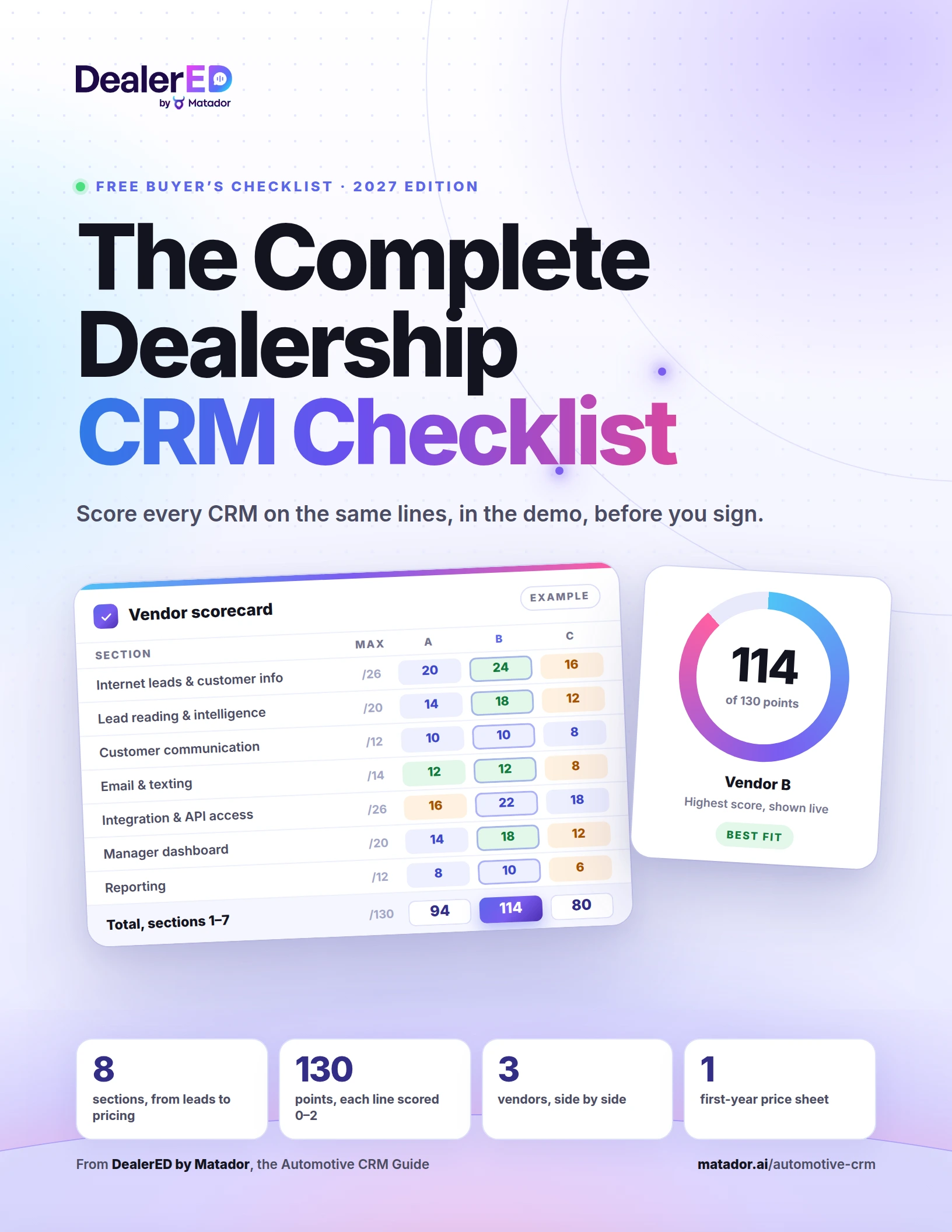
Six questions, six short answers
Read the answer, then click through to the detail. The checklist below puts every line on paper for the demo.
- 1What is in the free checklist?Eight sections, a demo test for each, real-scenario worksheets and a first-year price sheet.→
- 2What should an auto dealer CRM do?Eight things, from complete leads to an honest first-year price. Score each 0, 1 or 2.→
- 3Which CRM is best for your type of dealership?The one that scores highest on the lines your store weights most.→
- 4How do you choose a dealership CRM?Five steps: your own lead, the same script for every vendor, a score, the integration question, a first-year price.→
- 5How much does an auto dealer CRM cost?It depends on the configuration. Build one first-year number from eight cost lines.→
- 6Should you replace your CRM or keep it and add AI?Replace it when the record cannot be trusted. Keep it when the reply is the gap.→
What Is in the Free CRM Checklist?
Eight sections, seven of them scored to 130 points, with a demo test for each, real-scenario worksheets and a first-year price sheet. Print it, score every vendor on the same lines, and compare the totals before you compare the quotes.
The Complete Dealership CRM Checklist
Print it, take it into every demo, and score up to three vendors side by side.
- Eight sections, seven of them scored to 130 points, the same lines as this page
- Tests to run live in the demo, and a place to write what you saw
- The integration worksheet: what syncs, how often, at what cost
- The first-year pricing sheet, with the migration and training questions
- Real dealership scenarios to run with every vendor
- A scoring summary to compare up to three CRMs side by side
Your checklist is ready
If the download did not start on its own, the button below has it.
Download the checklist (PDF)What Should an Auto Dealer CRM Do?
Eight things, each scored 0, 1 or 2 for what the vendor showed you, not what the rep described. Sections 1 to 7 total 130 points; section 8, pricing, is one first-year number per vendor, compared on its own.
Does every lead arrive complete?Internet leads and customer information
Every lead arrives complete: source, type, the customer’s own comments, vehicle, stock number, VIN and trade. Duplicates merge without losing history. Routing follows your rules.
In practice. Log every walk-in, including the ones “just looking”, and re-confirm email and mobile at every touchpoint, service visits included. Keep the lead-source list short: two near-identical entries make new reps guess, and the guesses corrupt the ROI report.
How do you test it?Send the vendor a real lead and watch what the rep sees.
Does the system understand what the shopper asked?Lead reading and customer intelligence
The CRM, or the AI beside it, summarizes the request, flags unanswered questions and intent, surfaces objections, and recommends the next step in your own process.
In practice. Read every inquiry the customer has ever submitted, not only the active one; six leads in a week are six histories, and they may span several models. A wish list that matches stated needs to arriving inventory replaces the paper list walked across the lot each morning.
How do you test it?Submit a detailed lead and ask what the system understood.
Can a manager see who did what, and when?Customer communication history
One dated, attributed record: who did what and when, human or automation, with an audit trail of changes to customer, vehicle and trade data.
In practice. Sort active leads by last activity, not the task list; trainer Sean V. Bradley’s store audits keep finding prospects untouched for a week while the task list looked complete. Every attempt gets a note, including a turnover to a manager and what the manager said.
How do you test it?Open a record with weeks of activity. Can a manager follow it?
Can you text and email from the record, on your phone?Email and texting
Both channels live inside the record, with delivery and read status where supported, in order, on the mobile app as well as the desktop.
In practice. Text consent is an explicit opt-in stored on the record. Automated emails pause the moment a human engages, or the customer gets a template mid-conversation. Each template reports sent, read and replied counts, and the ones below your benchmark get rewritten.
How do you test it?Text and email the same customer from the mobile app.
Does it connect to the tools you already run?Integration and API access
Website, DMS, inventory, lead providers, phone, texting, digital retailing, desking, finance, trade tools, chat, data mining and AI: documented, with direction, frequency and fees.
In practice. Reconcile the sales log against the DMS daily so every sold customer carries a deal number and stops getting unsold follow-up. Ask what the service lane sends to sales: tomorrow’s appointments with equity, a repair order opening or closing above a dollar amount. Fewer logins means more usage.
How do you test it?For each tool you use today: what syncs, how often, at what cost?
Can a manager see what needs attention today?Manager dashboard visibility
New leads, unanswered leads, customers waiting, today’s and missed appointments, sold and unsold, employee activity and response time, across every rooftop.
In practice. Per salesperson: today’s completed activity, tasks due, overdue tasks with one click to the customers behind them, and the sent emails readable. One page per rep that combines tasks, appointments, service visits and recent leads is the screen for a five-minute daily one-on-one.
How do you test it?Show a sales manager’s first ten minutes of the day.
Can the store build its own reports?Reporting
Reports the store builds itself, with percentages and lead ROI rather than raw activity totals, plus leads without engagement, lost leads and gross where available.
In practice. Two reports experienced managers review every week: activity by salesperson, every figure drillable to the customers behind it, and lead-source ROI with leads, appointments, shown, sold, gross, cost per lead and profit by source. Manage activities, not closing ratio: when managers lean on the ratio, reps stop logging ups.
How do you test it?Recreate three reports you already run, live.
What will the first year really cost?Pricing
The complete first-year cost: base CRM with ILM and desking, rooftops, users, AI, texting, license scanning, integrations, implementation, migration and training.
In practice. Contracts commonly run three years, and a store whose managers never bought in is held to the term anyway. Price training alongside the subscription, monthly rather than once, and choose on fit and support rather than the lowest number.
How do you test it?Price the exact configuration that was demonstrated.
What software do auto dealers use?
Two core systems and the tools around them. The DMS is the record of deals, F&I, parts, service and accounting; the CRM holds customers, vehicles, leads and conversations. Website, inventory, desking, digital retailing, phones and texting sit around both, which is why requirement 5 asks how each one connects.
Where do the in-practice lines come from? They are paraphrased from the dealership trainers and CRM specialists credited on the best-practices page, which lays out the daily process behind each line, with diagrams, and names every source.
Which CRM Is Best for Your Type of Dealership?
The one that scores highest on the lines your store weights most. The checklist does not change from store to store; the weights do. Find your type, then weight the matrix.
Run a new-car franchise store?The franchise store
A new-car store runs on leads it does not fully control: manufacturer programs, marketplaces, its own website and the service drive. Some manufacturer programs keep an approved list of CRMs; check yours first.
- Reporting the OEM program accepts: response time, disposition and sold-from-lead, by source.
- A documented integration with the DMS the store already runs.
- Desking, trade and the F&I handoff inside the record.
The trapBuying the largest bundle because the DMS vendor sells one, then paying for modules nobody opens. Requirements first, discount second.
Run an independent or used-car lot?The independent or used-car lot
No manufacturer behind the store, and one person often running the whole internet department from a phone. Leads come from the marketplaces and the website, and the price has to fit one rooftop.
- Automotive, not generic: a vehicle record with stock number and VIN, and marketplace leads in the standard ADF format.
- Texting and email from the mobile app, with the history in one place.
- A clear monthly price for the users the store actually has, and a contract it can leave.
The trapTwo traps, in opposite directions: a spreadsheet or generic small-business CRM that cannot read an automotive lead, or a franchise-grade CRM priced for a store you are not.
Run several rooftops?The multi-rooftop group
Several stores, often several brands, frequently more than one DMS. The question is what the group can see across all of them, and whether a customer from one store is recognized at the next.
- Every rooftop on one screen, with the same definitions, so stores compare with their siblings.
- One customer record across stores, with lead routing between rooftops and permissions that match how the group is run.
- An integration with each store’s DMS, checked store by store.
The trapLetting each rooftop pick its own CRM, or forcing one onto stores whose DMS it has never met. Either way, the group reporting never arrives.
What are the top three CRMs for car dealers?
For your store, the three that score highest on your weighted checklist. General “top CRM” lists mostly rank business software that cannot read an ADF lead or hold a VIN, and dealer rankings weigh someone else’s store. Shortlist three, run the same lead through each, and let the totals rank them.
Where does the shortlist of CRM providers come from?
From what your store already runs. A franchise store starts with the CRMs its manufacturer program accepts and its DMS has a documented integration with. Every store then adds the ones peers of its own type use, and drops any that fail requirement 1 on a real lead.
How Hard Should You Argue Each Line?
Decisive should decide the shortlist; weigh it separates finalists; baseline means every serious vendor passes. Score all eight anyway: the weight changes what a low score costs you, not whether to look.
| Requirement | Franchise store | Independent or used-car lot | Multi-rooftop group |
|---|---|---|---|
| 1 · Leads and customer information | ●DecisiveOEM, marketplace and website leads arrive complete, with source, and merge cleanly. | ●DecisiveADF leads with the vehicle attached; duplicates merged when one shopper enquires three times. | ●DecisiveOne record per customer across rooftops, with routing and a lead-ownership rule. |
| 2 · Lead reading and customer intelligence | ●Weigh itVolume makes the summary useful: which leads asked a question nobody answered. | ●Weigh itFewer leads, one reader. The summary is the second pair of eyes. | ●Weigh itA standard: the same reading of intent at every store, so reports agree. |
| 3 · Communication history | ●DecisiveSales, BDC and service touch one customer; the record shows who did what, dated. | ●BaselineEasier to keep honest with two people. Check it is dated and cannot be edited silently. | ●DecisiveBought at store A, serviced at store B: one history, not two. |
| 4 · Email and texting | ●DecisiveBoth channels in the record and the mobile app, with consent under TCPA in the US and CASL in Canada. | ●DecisiveTexting is the channel. If the app cannot text from the record, a personal phone replaces the CRM. | ●DecisiveThe same consent and opt-out handling at every rooftop; a STOP at one store applies to all. |
| 5 · Integration and API access | ●DecisiveDMS, OEM feeds, inventory, phones, digital retailing, desking: direction, frequency and fee documented. | ●Weigh itFewer systems, but the marketplace feeds, website and inventory tool must be on the list, not promised. | ●DecisiveSeveral DMS platforms: every store’s DMS needs its own documented integration before signing. |
| 6 · Manager dashboard | ●Weigh itUnanswered leads, missed appointments and response time by salesperson, for the first ten minutes. | ●BaselineThe manager can see the floor. Weight the mobile view over the wall screen. | ●DecisiveEvery rooftop on one screen, comparable, with role-based views for group, store and salesperson. |
| 7 · Reporting | ●DecisiveReports the store builds itself, in percentages and lead ROI by source, plus what the OEM requires. | ●Weigh itThree reports you already run, recreated live. A vendor ticket means keep looking. | ●DecisiveSame definitions across stores, exportable, no ticket. This is what the group is buying. |
| 8 · Pricing | ●Weigh itPrice the configuration demonstrated: base with ILM and desking, users, texting, integrations, implementation. | ●DecisivePer-user pricing, the texting plan and the contract term decide whether one rooftop can afford it. | ●DecisiveRooftop fees multiply. Price per rooftop, user and integration, plus migration from each store’s CRM. |
Which report should you ask the demo for first?
Engagement counts and attempts per lead, at every type of store. CRM specialist Sam Maimone asks for them before lead volume, because they show whether leads are being worked at all.
What Else Should Change the Weights?
Franchise, independent or group is the first sort. Practitioners who configure CRMs for dealers add four more.
- Small town or metro? CRM specialist Sam Maimone says the same CRM should be configured differently for a small-town store and a metro store; the process that fits one market does not fit the other.
- No BDC? Aaron Van Voorhees, general sales manager at a single-point Illinois store with no BDC, describes salespeople who are hunters and farmers at once; a day with three deliveries wipes out that day’s cadence. Weight follow-up automation and the mobile app.
- Mostly used cars? Jasen Rice, a used-car inventory consultant, ties lead work to inventory: which vehicles have leads, which have none, which leads sit on sold units. Weight the vehicle record and inventory integration over lead-age reports.
- Heavy on fixed ops? Bill Wittenmyer, a longtime dealership manager speaking in 2016 for a CRM vendor, expects the CRM to serve the service lane as a sales channel, with equity alerts and repair-order triggers. Weight the DMS and service integration.
How Do You Choose the Right Dealership CRM?
Bring your own scenarios and ask every vendor the same questions in the same order. A prepared demo shows a CRM under ideal conditions. Yours shows the store, and you leave with a number instead of an impression.
Bring your own scenarios
One real internet lead with a trade and a question, three reports you already run, and the list of systems the store uses today.
Same lead, every vendor
Submit the identical lead, ask the identical questions, in the identical order. A prepared demo shows ideal conditions; yours shows the store.
Score, don’t admire
Every line of the checklist gets a 0, 1 or 2 for what you saw, not what the rep described. Sections 1 to 7 total 130 points.
Ask the integration question
For each product you use: what data syncs, in which direction, how often, and at what extra cost. A lead-only connection is not a sync.
Price the whole first year
Base CRM with ILM and desking, rooftops, users, AI, texting, scanning, integrations, implementation, migration, training. One number per vendor.
What should you do before the first demo?
Write a discovery. Sam Maimone’s first step with any store that wants to buy or switch is to sit with the managers and write down how walk-ins, web leads and phone-ups are handled today, where the gaps are and what each costs. Then map every CRM to that document.
When should you wait before buying?
When key managers will not buy in. That is Maimone’s rule, because CRM contracts commonly run three years, and a principal who wants out after six months because nobody adopted the system is held to the term.
Should you score the vendor’s people too?
Yes. Ask what the account manager does after go-live. Mark Vickery, who leads performance management at a CRM vendor, holds his team to coming into the store and saying what it is doing wrong. If the role on offer is training and tickets, budget for coaching elsewhere.
What counts for more than the feature list?
Mobile and integration depth. Notes, appraisals and contacts get logged on the lot or not at all. And fewer logins means more usage, so the CRM should be the one screen that pulls in website, inventory, desking and service data.
How Much Does an Auto Dealer CRM Cost?
It depends on the configuration, so build one first-year number from its parts. This page gives no dollar figures: it gives the components every quote is built from, the order to price them, and the question each type should ask. Requirement 8 is the same test in one line.
Count the units
Per rooftop, then per user or seat band; a group pays both, multiplied. Count everyone who touches a record, service advisors included.
Rooftops × usersPrice the base
ILM plus desking is usually the base: receiving and routing internet leads, and structuring the deal. Confirm what is a module.
ILM + deskingAdd the running costs
Texting, per message, user or rooftop. Each integration (DMS, inventory, phones, lead providers), some charged on both sides. AI. License scanning.
MonthlyAdd the one-time costs
Implementation, migration of the current CRM’s records and history, and training. Ask what migrates: customers only, or history too.
First yearHow much does a dealer CRM cost per month?
Rooftops times users, plus texting and each integration. Ask for it in those parts, then add the one-time costs for the first year. Two quotes compare only when they price the same configuration.
Is there a free CRM for car dealerships?
Free generic CRMs exist, but a generic small-business CRM cannot read the ADF lead a marketplace sends or hold a vehicle record with a stock number. If a free plan is on the table, score it like any other, and still price the first year: texting, integrations and training cost money even when the license does not.
Which Cost Lines Matter Most for Your Store?
- Rooftops. The group’s multiplier. Ask whether the fee is per rooftop or per legal entity.
- Users. The independent’s lever: pay for the people who touch a record, not a seat band sized for a franchise floor.
- ILM plus desking. The base everywhere. An independent that desks elsewhere should ask whether ILM is sold alone.
- Texting. Decisive for independents. Per message, user or rooftop; ask whether consent capture and opt-outs are included.
- Integrations. The franchise store’s largest line after the base. Groups price each store’s DMS separately.
- Implementation. Who does it, how long it takes, what the store must provide. Groups: a plan store by store.
- Migration. A group leaving several CRMs needs a quote per store. Ask what moves: customers only, or history too.
- Training. Once or ongoing, on site or remote. Independents: is it included? Groups: can we train our trainers?
What Costs Does No Quote Show?
Practitioners who roll these systems out put the term and the training ahead of the monthly price.
- How long is the term? CRM specialist Sam Maimone says contracts commonly run three years, and describes principals demanding out after six months because their managers never adopted the system, and being held to the term. Ask for the exit terms before the discount.
- Is training priced monthly? It should be. Maimone’s rule: a tool paid for monthly deserves training monthly; a one-off seminar retains little. Mark Vickery, performance-management lead at a CRM vendor, sees usage decay within two or three months once training stops.
Should You Replace Your CRM,
or Keep It and Add AI?
Replace it when the record cannot be trusted; keep it when the reply is the gap. Low marks on requirements 1, 3, 4, 5 and 7 are a CRM problem. High marks with leads still waiting until morning for a reply is a different problem, with a different fix.
Is the record itself the problem?
- –Leads arrive incomplete or get lost between sources, and duplicates do not merge.
- –The communication history is undated, unattributed, or can be edited without a trace.
- –Texting and email live outside the record, or the mobile app cannot do them.
- –Systems you run today (DMS, inventory, phones) have no documented integration.
- –A report the manager needs takes a vendor ticket instead of ten minutes.
Before you replace it, be sure the problem is the system and not how it is run; several of these show up in a CRM left on the vendor’s defaults. If the problem is how the CRM is run, start here.
Is the data fine, but the reply too slow?
- +New leads wait hours, or a weekend, for a first reply.
- +Follow-up stops after the third attempt because people run out of time, not leads.
- +The team lives in the CRM and will not adopt a second screen, so the AI has to work inside it.
- +You would be switching mainly to get AI features. Those can be added to the CRM you have.
- +You want the appointments sitting in the leads you already paid for, before paying to migrate them.
Matador is not a CRM; it is conversational AI that works alongside the one you keep. What Matador adds, and how it connects to the CRM you have.
More questions about choosing an auto dealer CRM
What should a dealership CRM be able to do in 2027?
What is the best CRM for a car dealership?
How do I know whether a specific dealer CRM is any good?
How do I compare CRM vendors fairly?
Do I need a CRM as a small independent or used-car dealer?
Independent dealer CRM vs franchise dealer CRM: what is actually different?
Can one CRM run multiple rooftops?
How much does an auto dealer CRM cost?
What is ILM in a dealership CRM?
The rest of the Automotive CRM Guide
The Automotive CRM Guide for Dealers
The short version of the whole decision: what a dealership CRM must do, how to score one, what running it well looks like, and when to add AI instead.
Open the guide →Best practicesAutomotive Lead Management: How the Best-Run Stores Do It
The processes and daily habits the people who train dealerships on their CRM teach, drawn as diagrams you can hold your store against.
Read →Matador IntegrationsMatador Is Not a Dealership CRM. It Integrates With Yours.
What conversational AI adds to a dealership CRM, how it connects to fourteen CRM and DMS platforms, and what syncs in which direction.
Read →Buyer’s guideAI for Automotive Dealerships: The Practical Guide
Use cases by department, the questions to ask vendors, what implementation involves, and how to read the ROI.
Read →Industry mapAI in the Automotive Industry in 2027
From design and the factory floor to the car, the supply chain and the dealership: where AI is at work, and where it is not yet.
Read →Take the Checklist Into the Demo.
Then See What AI Adds.
The PDF is free and needs no call. When the scores are in, twenty minutes with our team shows what Matador adds to the CRM you keep: we connect to it, replay real leads from your store, and show you the appointments sitting in them.