AI for Automotive Dealerships:
The Practical Buyer’s Guide
Seven questions a dealer principal, GM or BDC manager should answer before buying AI for the store, from what it does in each department to how to read the ROI you will be shown.
≡Part of the Automotive CRM Guide for Dealers →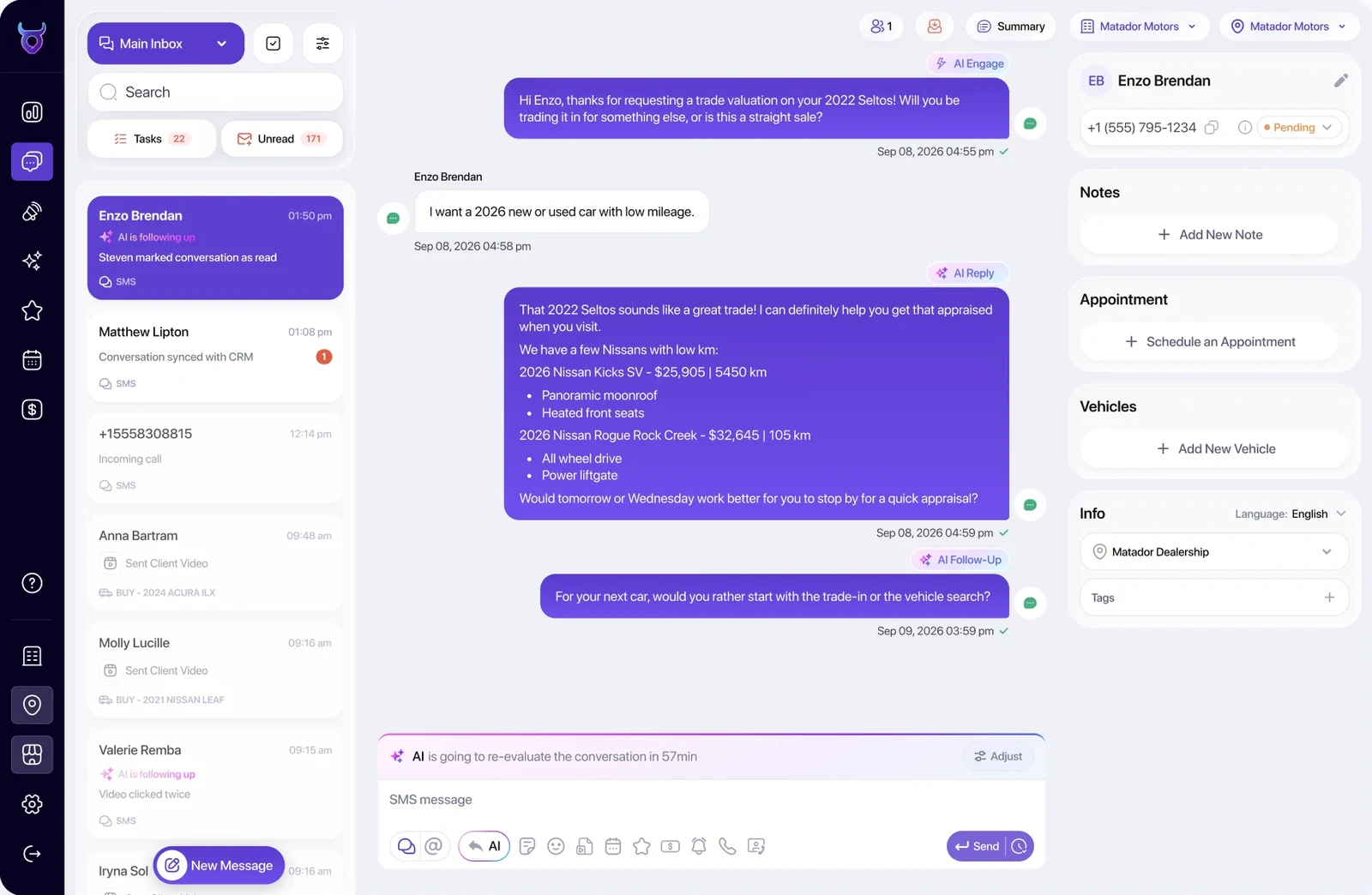 AI agents and the team on one queue
Seven questions, seven short answers
Read the answer, then click through to the detail behind it. Every Matador figure is one the site publishes, and every practitioner is named.
- 1What does AI for automotive mean at a dealership?Software that talks to customers and acts, or software that scores, prices and writes for a person.→
- 2How are car dealerships using AI?In five departments, from sales to service. What it writes back to the CRM matters most.→
- 3How do you choose the best AI for a dealership?Ask every vendor the same seven questions, then check the answers on your own leads.→
- 4How long does it take to put AI into a store?Days to go live, weeks to tune. The store’s own rules take longest.→
- 5How do you know if dealership AI is working?Four numbers, led by appointments influenced and show rate, against your month before.→
- 6Should you hire a BDC or add AI?Most stores end up with both. The AI takes the first reply; the BDC takes the customer.→
- 7Where does Matador fit?Five agents and one inbox, alongside the CRM you already have.→
What Does AI for Automotive Mean at a Dealership?
Two kinds of software sold under the same two words. One converses and acts: it answers a lead or a call from live data, books the appointment, follows up and writes it all back to the CRM. The other scores, prices or writes, and hands the result to a person.
How do you judge the two kinds?
Differently. A scoring tool is judged on whether its output is right. An agent is judged on what it does with your customers at 9 PM, what it writes back, and whether a salesperson can take over without a seam. Most of this guide is about agents, where the money and the risk both sit.
Who at the store buys it?
The dealer principal or GM signs. The GSM or BDC manager lives with it, and the service director owns it on the phones.
Why are dealers looking at it now?
Three reasons. Agents have replaced scripted website widgets; texting consent rules (TCPA in the US, CASL in Canada) make blast-and-hope a liability; and the CRM you already own can receive what the AI does.
Is it the same as AI in the automotive industry?
No. The industry term also covers design, the factory, the supply chain and the car itself; that map is on AI in the automotive industry. For the CRM alone, start with the Automotive CRM Guide.
How Are Car Dealerships Using AI Today?
In five departments, and what matters most is what each one writes back to the CRM. Read the highlighted column first; the last column separates a demo from a deployment.
| Department | What does AI do today? | What does it write back to the CRM or DMS? | What should you ask? |
|---|---|---|---|
| SalesAgents, plus scoring and pricing tools | Replies to every lead in seconds, converses on live inventory, books the appointment and follows up for months. Scoring and pricing tools hand a person a list or a number. | Every message, attributed to the AI; the appointment; the lead’s stage and consent status. | Show me the conversation on one of our own leads, then the CRM record afterwards. |
| BDC and internetAgents | Covers the hours the BDC cannot: nights, weekends, the Saturday rush. Takes the first reply and the routine questions; the shift goes to live customers. | The thread, the hand-off point, and who owns the lead now. | Who can take over, from where, and does the AI stand down when they do? |
| Service and fixed opsAgents, plus DMS data | Answers the service line, books into the scheduler, sends reminders that book, and reads repair-order status so the customer is kept informed. | Appointments to the scheduler; repair-order status read from the DMS; the review invite when the order closes. | Which scheduler and DMS does it read and write, live or from a nightly file? |
| MarketingAgents and writing tools | Sends outreach triggered by CRM data (equity and lease-end alerts, price drops, lost-lead revival) and handles the reply. Writing tools draft the ad or email for approval. | The campaign touch and every reply on the record; the opt-out the moment it arrives. | How is consent checked before a send, and where does a STOP go? |
| ManagementReporting and analysis | Turns the conversation log into a report: appointments influenced, show rate, response coverage by hour, per-agent and per-rooftop performance, where the store leaks deals. | Nothing. It reads from the CRM; the output is the dashboard and the plan. | Can I see appointments influenced and show rate per store without exporting a spreadsheet? |
What is automotive AI chat?
An agent that holds the conversation by text or on the website, answering from live inventory, capturing the lead and booking the visit. A scripted widget that collects a phone number is not one. Dealership CRM with AI chatbots compares the kinds, and its what-syncs table shows how each connects to the CRM.
How does AI help a car salesperson?
It takes the first reply, the routine questions, the booking and the follow-up nobody had time for. The salesperson steps into the thread from the CRM, and the AI stands down. The process from lead to appointment is in Automotive lead management.
How Do You Choose the Best AI for Your Dealership?
Ask every vendor the same seven questions, in this order, then check the answers on your own leads. No product is best for every store. Each card’s footer is what a good answer sounds like.
Where do the answers come from?
A script or a guess on pricing loses the customer. It should answer from live inventory and the store’s own rules, and say when it does not know.
A good answerYour inventory feed and per-store rules, plus what it says when it does not know.
What does it write back, and where?
A conversation that never reaches the CRM record cannot be managed, audited or reported. Ask which objects sync (messages, appointments, ownership, opt-outs), how often, which direction.
A good answerA list of objects with direction and frequency, per CRM, in writing.
Who can take over, and how?
A salesperson must be able to step into the thread mid-conversation, from the CRM they live in, and the AI must stand down rather than text over them. Sean V. Bradley, a dealership process trainer, makes this his first fix in any store, AI or not: the automated cadence switches off the moment a rep has a conversation.
A good answerA live hand-off in the demo: the AI goes quiet; the thread opens from the CRM record.
How are consent and opt-outs handled?
TCPA in the US, CASL in Canada. Consent recorded before outreach, and a STOP that reaches every connected system, not just the vendor’s dashboard.
A good answerConsent status beside every conversation; opt-outs pushed to the CRM so the two never disagree.
What does it cost in the first year?
The subscription is one line. Texting carries carrier and number-registration fees, the CRM vendor may charge for the integration, and onboarding and training come on top.
A good answerA first-year total, by line, before you ask for it.
How is success measured?
In appointments influenced and shown, per agent and per rooftop, not in messages sent. Texts are activity; an appointment that showed is a result.
A good answerAppointments influenced and show rate on a dashboard, and a plain definition of “influenced”.
What is the commitment?
Term length, what happens at the end, and what it takes to leave with your data. A vendor who states it plainly is easier to trust; Matador, for example, states a six-month minimum.
A good answerThe term in one sentence, before the contract arrives.
How do you check the answers?
On your own leads. Submit the same real lead to every vendor and score what you were shown, not what was described, with the scored checklist.
Get the scored checklist →What should you write down before the first demo?
What breaks today. The seven questions judge a vendor; a written account of your own process is what you judge the answers against.
How does the process run today?
Write it down with the management team. Sam Maimone, a CRM specialist who has worked on the dealership, vendor and manufacturer sides, has dealers document how walk-ins, web leads and phone-ups are handled before they buy. The same document later settles who committed to what.
Where does it break?
Name the step. Aaron Van Voorhees, general sales manager at a single-point Illinois store with no BDC, could name his: when a rep delivers three cars in a day, at about two hours each, first contact on web leads does not happen. His pilot targets that step and nothing else.
What will the fix be judged by?
A number you choose before the pilot, not after. Put even a rough figure on the leads that got no first contact, then judge the tool against that document rather than the demo.
How Long Does It Take to
Put AI Into a Store?
Days to go live, weeks to get right. Matador reports most stores connect in under an hour and are live within days; ask any vendor for its own numbers. Expect step three, the store’s own decisions, to take longer than the software.
Kickoff and credentials
Name the store’s owner for the project and agree the pilot: which rooftops, which lead sources, sales or service first. Hand over CRM, DMS and texting credentials and ask for the security attestation; Matador’s is SOC 2 Type II.
Day oneConnect the CRM and DMS
The vendor connects to the CRM you already run and, for service, the scheduler and DMS. On a certified or two-way integration this is configuration, not a project; Matador reports most stores connect in under an hour.
Under an hourConfigure the store’s rules
Pricing answers (a range, a hand-off, or an appointment for the numbers), hours and hand-off rules, who gets which lead, what the AI must never say, and the consent language on the first text.
Before go-livePilot on real leads
One source or one rooftop first. Read the conversations daily, watch the hand-offs, fix the rule behind every awkward reply. Matador says most stores are live within days; the pilot shows whether that holds for yours.
Weeks 1 to 4Measure and tune
Appointments influenced and show rate against the month before. A monthly review of every conversation, which is what Matador’s AI Scorecard does, names where the store still leaks deals and plans the next 30 days.
Every monthWhat if we are one of the first stores on it?
Say so, and budget the attention it needs. Van Voorhees knew his store was among the first in its CRM vendor’s AI texting program and went in as a conscious pilot participant: a test site, not the customer of a finished product.
Will the AI make mistakes at first?
Yes, so train it like a new employee. In Van Voorhees’s view it arrives with a standard, your store differs, and it has to learn your policies. Unlike a new hire, each behavior gets fixed once rather than five times.
How Do You Know If Dealership AI Is Working?
Read four numbers together, against your own month before. Below are the three results Matador publishes, with sources, then what any such number can and cannot tell you.
What can each number tell you, and what can’t it?
Is it creating appointments?Appointments influenced
How many appointments had the AI in the thread before they were set: the number closest to revenue that software can count, compared month over month.
What it cannot tell youWhether it would have been set anyway, or whether it sold. Read it beside show rate and the CRM’s sold report.
Are the appointments real?Show rate
Whether the appointments the AI books are real: confirmed, reminded and kept. A high rate means the conversation qualified the customer, not just named a time.
What it cannot tell youThe volume behind it. A strong rate on a handful of appointments is not a result; ask for the base.
Is every lead answered fast?Response-time coverage
What share of leads got a reply within minutes, by hour and day. The nights-and-weekends gap is most stores’ biggest leak and the first thing AI closes.
What it cannot tell youWhether the reply was any good. Coverage is a floor, not a grade; read a sample of transcripts weekly.
Are stalled leads being worked?Follow-up coverage
How many stalled leads got a touch with a reason to return, and how many answered. Compare with how many of those leads anyone was working before.
What it cannot tell youSeparate the AI’s work from a price drop or new arrival that would have brought the customer back anyway.
What else should you watch in the first months?
What one general sales manager watched early in his pilot. The habits hold for any store.
Is it fixing the step we bought it for?
Count that step. If first contact is the leak, count the new leads the AI reached and the engaged shoppers it passed to a salesperson.
Is it better than our people were?
Mystery-shop your own store first to find out: time the first human reply and read it. Then judge the AI against that baseline, not against zero.
What does a long AI conversation cost?
Real money. The hosts of a dealer podcast who sell AI tools describe a shopper’s own assistant answering the dealership’s for fifteen or twenty minutes, and every message costs. Put a length cap and a cost-per-conversation column on the dashboard.
How long should a pilot run before we judge it?
Months, not weeks. A couple of months in, Van Voorhees had little to show from the texting pilot and treated that as too early rather than as failure. Agree the review horizon with the vendor before go-live and hold both sides to it.
Will another store’s result happen at ours?
Not necessarily, so ask how any figure was measured and over what base. Matador’s analytics report appointments influenced and show rate per agent and rooftop; the AI Scorecard reads the conversations behind them each month.
Should You Hire a BDC or Add AI to the Team You Have?
Most stores end up with both. Four things differ between the two, and neither column is the whole answer.
Hire or outsource a BDC
- 1Coverage. A shift. Evenings and weekends need a second shift or an outsourced desk; the 9 PM lead waits for one or the other.
- 2Consistency. Depends on the person. The best BDC agent is excellent; the newest is learning on your leads, and with turnover someone always is.
- 3Cost structure. Salaries, benefits, recruiting, training and turnover in-house; a per-seat, per-lead or per-appointment fee outsourced, usually on its scripts rather than yours.
- 4Strongest at. Reading a hesitant customer, the trade-in conversation, the call that has gone wrong, and the rapport that carries into the showroom.
Add AI to the team you have
- 1Coverage. Every lead, every hour, in seconds, including the Sunday-night one. The team starts Monday with conversations open and appointments set.
- 2Consistency. The same answer from the same live inventory and rules, on the first lead of the day and the four-hundredth. No bad weeks.
- 3Cost structure. A subscription per rooftop plus texting and integration fees; no recruiting, training or turnover. Price it as a first-year total beside the cost of a hire.
- 4Strongest at. The first reply, the routine questions, the appointment, and the follow-up nobody had time for. It books; your people still sell.
Does AI replace the BDC?
In practice, no. The AI takes the first reply, the routine questions, the appointment and the follow-up, and covers the hours the BDC cannot. The BDC spends its shift on the hesitant buyer, the trade-in and the call that has gone wrong. Why AI is not replacing your BDC.
What if the store has no BDC at all?
Then the case is sharpest, because delivery days wipe out the follow-up. Van Voorhees, fourteen years at such a store, worried about handing a process his business had run the same way for eighty years to something he does not fully understand. He concluded it is coming regardless: adopt it or fall behind.
Where Does Matador Fit
With the CRM You Have?
Five agents and one inbox, working alongside the CRM you already run. Matador is not a CRM. It runs at 1,500+ rooftops, is rated 4.8 out of 5 on G2, is SOC 2 Type II certified, and is based in Laval, Quebec.
AI Engage
Opens every new lead in about 30 seconds with a message shaped by lead source and intent, and hands off the moment the customer replies.
See AI Engage →AgentAI Reply
The AI BDC: runs the live conversation on real-time inventory, answers day or night, and books the appointment itself.
See AI Reply →AgentAI Follow-Up
Decides who to re-engage, when and what to say, and works stalled leads for up to 180 days with a real reason to come back.
See AI Follow-Up →AgentCall AI
Answers dealership calls as receptionist, sales line and service scheduler, and books service into Xtime.
See Call AI →AgentChat AI
Website chat that answers pricing and availability from live inventory, captures the lead in the conversation, and books.
See Chat AI →What surrounds the agents?
- Omni-channel inbox: agents and team on one queue, one thread per customer.
- Analytics and the AI Scorecard: appointments influenced per agent and rooftop, and a monthly read of every conversation.
- Automations: equity and lease alerts, lost-lead revival, service reminders that book.
- Browser extension and mobile apps: text from inside any CRM.
Which CRMs and DMS platforms does it connect to?
Certified partner of eLead, VinSolutions, DealerSocket and the Xtime scheduler. Two-way sync with Activix, DealerCX, DealerPeak and TMS. Service data from the Tekion, Reynolds, CDK Drive, Dealertrack, PBS and Titan DMS platforms. Most stores connect in under an hour and are live within days; the full directory has 62 connections.
Where can we see it for our department?
On the pages for sales, service and fixed ops, OEM programs and dealer groups, and powersports. Bring the seven questions to the demo.
AI for automotive dealerships, answered
What is AI for automotive?
How are car dealerships using AI?
Which AI is best for car dealerships?
Does AI replace the BDC?
How much does AI for a dealership cost?
How long does it take to implement AI at a dealership?
Is dealership AI compliant with texting laws?
How do I measure whether dealership AI is working?
How long should a dealership AI pilot run before we judge it?
Do I need a new CRM to use AI at my dealership?
The rest of the Automotive CRM Guide
The Automotive CRM Guide for Dealers
The short version of the whole decision: what a dealership CRM must do, how to score one, what running it well looks like, and when to add AI instead.
Open the guide →The checklistThe Auto Dealer CRM Checklist: Score Any CRM Before You Sign
Eight requirements with a demo test for each, weighted for your type of dealership, and the first-year price sheet. Free PDF.
Read →Best practicesAutomotive Lead Management: How the Best-Run Stores Do It
The processes and daily habits the people who train dealerships on their CRM teach, drawn as diagrams you can hold your store against.
Read →Matador IntegrationsMatador Is Not a Dealership CRM. It Integrates With Yours.
What conversational AI adds to a dealership CRM, how it connects to fourteen CRM and DMS platforms, and what syncs in which direction.
Read →Industry mapAI in the Automotive Industry in 2027
From design and the factory floor to the car, the supply chain and the dealership: where AI is at work, and where it is not yet.
Read →PlatformThe AI Scorecard: a monthly read of every conversation
Where the store leaks deals, named from the transcripts each month, with a 30-day plan for the team.
Open →From the blogProving ROI on AI: how dealerships turn automation into revenue
The four places stores running Matador find the return: after-hours response, the leads already in the CRM, the service drive, and the team’s time.
Open →Bring Your Own Leads.
We Will Show You the Appointments.
Twenty minutes with our team. We connect to the CRM you have, replay real leads from your store, and show you the appointments sitting in them right now. Bring the seven questions.